
After protein, fiber is the next thing I look at with my patients. And it’s the one that slips the most.
On a GLP-1, you eat less, so you get less fiber too. Many of my patients find out the hard way, with constipation. In menopause, fiber matters for more than your gut. It helps keep your blood sugar steady, lowers your cholesterol (which tends to creep up in this stage), and keeps you full longer.
Getting enough fiber is harder than it sounds. Over time, I’ve learned that unless you put some thought into it, it just doesn’t happen. So I make sure everything on my plate has some fiber, and I give the same advice to my patients.
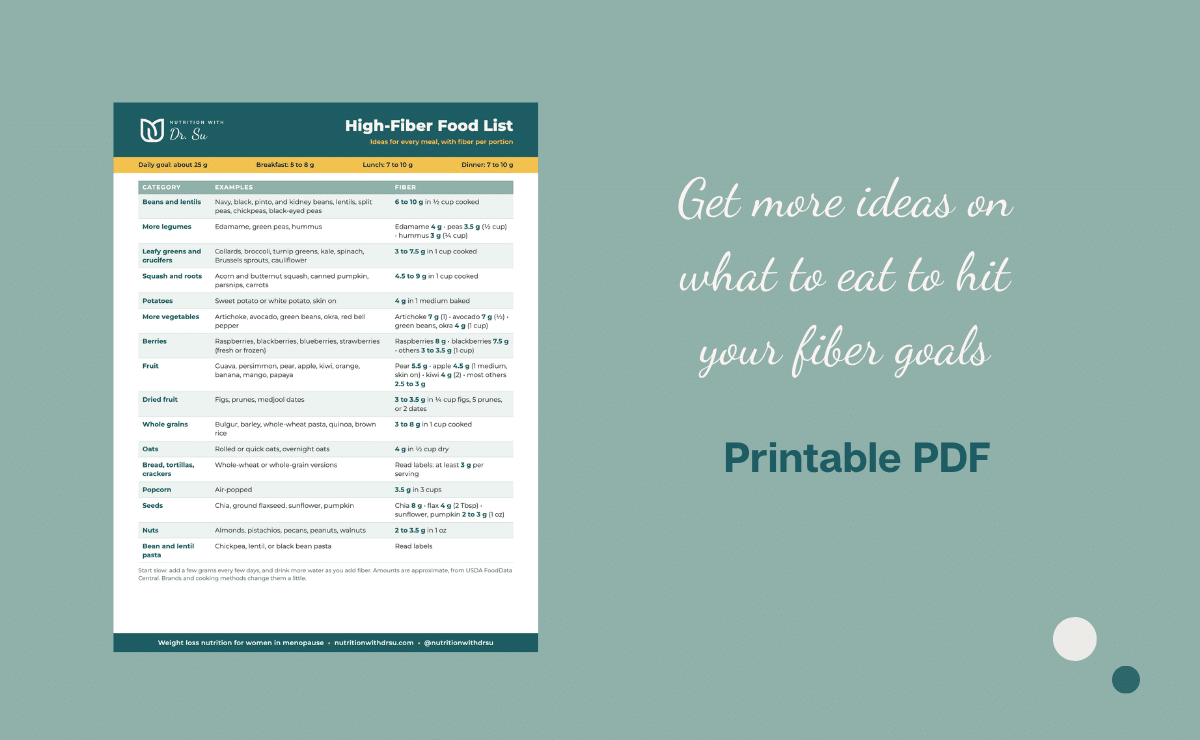
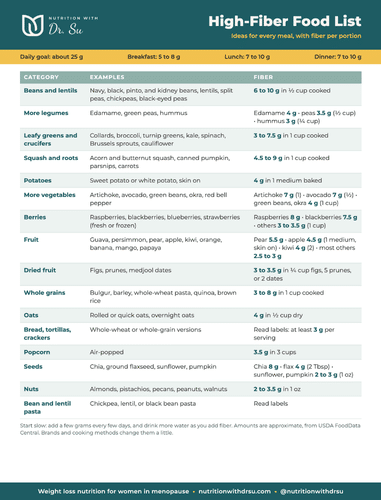
To make that easier, I made a free printable list of high-fiber foods you can keep on your fridge or take to the store. This post walks through each group, with how much fiber you get from a normal portion.
Medical disclaimer: This content is for educational purposes only and is not a substitute for medical advice, diagnosis, or treatment.
Get the free printable High-Fiber Food List
How Much Fiber Do You Need?
Most women need about 25 grams of fiber a day. The Academy of Nutrition and Dietetics recommends 14 grams for every 1,000 calories you eat, so if you’re eating less on a GLP-1, your number may be a little lower.
A daily number can feel like a lot, so break it up:
- Breakfast: 5 to 8 grams
- Lunch: 7 to 10 grams
- Dinner: 7 to 10 grams
- Snacks: if you snack, add a fiber food. A pear has about 5 grams.
Start Slow
More fiber is the goal, but how you get there matters.
- Add it gradually. Add a few grams every few days. Going from 10 grams to 25 overnight is a recipe for gas and bloating.
- Drink more as you add more. Fiber needs water to do its job. Without enough fluids, it can make constipation worse.
High-Fiber Food List
Scroll down for the full list, or download the free printable version here.
The fiber amounts below are approximate and rounded. Brands and cooking methods change them a little, so use them to get a feel for portions, not to count every gram.
Beans and Legumes
Fiber champions, and a bonus for you: they have protein, too. If you change only one thing, make it this. Add beans to your salad, swap rice for rice and beans, or toss peas or edamame into whatever you’re making. Canned beans count; just rinse them.
- Navy beans, 1/2 cup cooked: about 10 g
- Split peas, 1/2 cup cooked: about 8 g
- Lentils, 1/2 cup cooked: about 8 g
- Black beans, 1/2 cup cooked: about 7.5 g
- Pinto beans, 1/2 cup cooked: about 7.5 g
- Kidney beans, 1/2 cup cooked: about 6 g
- Chickpeas, 1/2 cup cooked: about 6 g
- Black-eyed peas, 1/2 cup cooked: about 5.5 g
- Edamame, 1/2 cup shelled: about 4 g
- Green peas, 1/2 cup cooked: about 3.5 g
- Hummus, 1/4 cup: about 3 g
Bean and lentil pastas usually have more fiber and protein than wheat pasta. Check the label.
Vegetables
Every vegetable adds fiber, and cooked vegetables shrink down, so you get more fiber in fewer bites. That helps when your appetite is small.
- Acorn squash, 1 cup baked: about 9 g
- Collard greens, 1 cup cooked: about 7.5 g
- Artichoke, 1 medium cooked: about 7 g
- Avocado, 1/2: about 7 g
- Canned pumpkin, 1 cup: about 7 g
- Butternut squash, 1 cup baked: about 6.5 g
- Parsnips, 1 cup cooked: about 5.5 g
- Broccoli, 1 cup cooked: about 5 g
- Turnip greens, 1 cup cooked: about 5 g
- Carrots, 1 cup cooked: about 4.5 g
- Kale, 1 cup cooked: about 4.5 g
- Spinach, 1 cup cooked: about 4 g
- Brussels sprouts, 1 cup cooked: about 4 g
- Green beans, 1 cup cooked: about 4 g
- Okra, 1 cup cooked: about 4 g
- Potato or sweet potato, 1 medium baked: about 4 g (eat the skin)
- Red bell pepper, 1 cup raw: about 3 g
- Cauliflower, 1 cup cooked: about 3 g
Fruits
Whole fruit, not juice. Berries are the stars, especially raspberries and blackberries, and frozen counts.
- Guava, 1 cup: about 9 g
- Raspberries, 1 cup: about 8 g
- Blackberries, 1 cup: about 7.5 g
- Persimmon, 1: about 6 g
- Pear, 1 medium with skin: about 5.5 g
- Apple, 1 medium with skin: about 4.5 g
- Kiwi, 2: about 4 g
- Dried figs, 1/4 cup: about 3.5 g
- Blueberries, 1 cup: about 3.5 g
- Pomegranate seeds, 1/2 cup: about 3.5 g
- Prunes, 5: about 3.5 g
- Medjool dates, 2: about 3 g
- Orange, 1 medium: about 3 g
- Banana, 1 medium: about 3 g
- Strawberries, 1 cup: about 3 g
- Mango, 1 cup: about 2.5 g
- Papaya, 1 cup: about 2.5 g
Whole Grains
Swap the refined version for the whole-grain one. Same meal, more fiber. Bread, tortillas, and crackers vary a lot by brand, so check the label and look for at least 3 grams per serving.
- Bulgur, 1 cup cooked: about 8 g
- Barley, 1 cup cooked: about 6 g
- Whole-wheat pasta, 1 cup cooked: about 5 g
- Quinoa, 1 cup cooked: about 5 g
- Oats, 1/2 cup dry: about 4 g
- Whole-wheat tortilla, 1: about 4 g
- Popcorn, 3 cups air-popped: about 3.5 g
- Brown rice, 1 cup cooked: about 3 g
- Whole-wheat crackers, 1 ounce: about 3 g
- Whole-wheat bread, 1 slice: about 2 g
Nuts and Seeds
Small amounts, high in fiber, and easy to sprinkle on foods you already eat, like yogurt, oatmeal, salads, or smoothies. Chia seeds are the winner here.
- Chia seeds, 2 tablespoons: about 8 g
- Ground flaxseed, 2 tablespoons: about 4 g
- Almonds, 1 ounce: about 3.5 g
- Sunflower seeds, 1 ounce: about 3 g
- Pistachios, 1 ounce: about 3 g
- Pecans, 1 ounce: about 2.5 g
- Peanuts, 1 ounce: about 2.5 g
- Walnuts, 1 ounce: about 2 g
- Pumpkin seeds, 1 ounce: about 2 g
Small Bites, Big Fiber: Tips for Low-Appetite Days
When your appetite is small, a big salad can feel impossible. These add a lot of fiber without a lot of volume:
- Stir 1 to 2 tablespoons of chia seeds or ground flaxseed into yogurt, oatmeal, or a smoothie.
- Choose raspberries or blackberries over other fruit. Same handful, twice the fiber.
- Add 1/4 cup of beans or lentils to a soup or salad.
- Use bean or lentil pasta instead of regular pasta.
- Eat cooked vegetables instead of raw. They shrink, so you get more in less space.
- Snack on a pear or 2 kiwis with a cheese stick or a few nuts.
Social media also has creative ideas, like adding beans to unexpected foods such as avocado toast or smoothies. Keep an eye on new trends and try the ones you’re brave enough for. Just add them slowly.
Easy High-Fiber Meal Ideas
Breakfast
- Overnight oats with chia seeds, raspberries, and Greek yogurt
- Avocado toast with a twist: mash white beans into the avocado and spread it on whole-grain bread
- A smoothie with frozen berries, Greek yogurt, milk, and ground flaxseed
Lunch
- Quinoa and black bean salad with chicken, tomato, cucumber, cilantro, and lime
- Lentil soup with chicken or turkey sausage, and a side of whole-grain crackers
- A veggie bowl with grilled chicken or tofu, brown rice, and roasted vegetables
Dinner
- Chickpea pasta with marinara, ground turkey, and spinach
- Baked salmon with roasted Brussels sprouts and a sweet potato, skin on
- Air-fried chicken with an edamame and cucumber salad
Snacks
- Greek yogurt with chia seeds and berries
- A handful of pistachios with a clementine
- Hummus with baby carrots or whole-grain crackers
- Air-popped popcorn
Pairing fiber with protein, like in these snacks, keeps you full longer. For protein ideas, see my High-Protein Foods List.
Soluble vs. Insoluble Fiber
Fiber comes in two types, and you need both. Most plant foods have some of each.
- Soluble fiber dissolves in water and forms a gel. It softens stool, helps keep blood sugar steady, helps lower cholesterol, and feeds the good bacteria in your gut. Find it in oats, beans, lentils, apples, citrus, carrots, barley, chia seeds, and psyllium.
- Insoluble fiber doesn’t dissolve. It adds bulk and helps things move through your gut. Find it in whole-wheat bread, wheat bran, brown rice, nuts, and the skins of fruits and vegetables.
What About Fiber Supplements?
Food comes first because it provides vitamins, minerals, and other nutrients a supplement can’t. But on days when your appetite is low, or if you’re constipated, a fiber supplement can help fill the gap. I walk through the options and when to use them in GLP-1 Constipation Relief.
Reading the Label
On a nutrition label, fiber is listed under Total Carbohydrate as “Dietary Fiber.” A food with about 3 grams per serving is a good source, and 6 grams or more is excellent.
The Bottom Line
Fiber is one of the simplest ways to feel better on a GLP-1 and in menopause. Aim for about 25 grams a day, add it slowly, drink more water as you go, and try to get some fiber on every plate.
If you’d like help building a plan that works for your appetite and your medication, I work with patients one-on-one and accept insurance. Book your appointment here.
More on gut health: Menopause and Constipation and How to Heal Your Gut in Menopause.

Dr. Su-Nui Escobar, DCN, RDN, FAND, is a Miami-based weight loss dietitian specializing in women in menopause who use GLP-1 medications. She holds a doctorate in clinical nutrition from the University of North Florida and is a national speaker, writer, and author of The GLP-1 Kitchen. She is a former spokesperson for the Academy of Nutrition and Dietetics.person.