
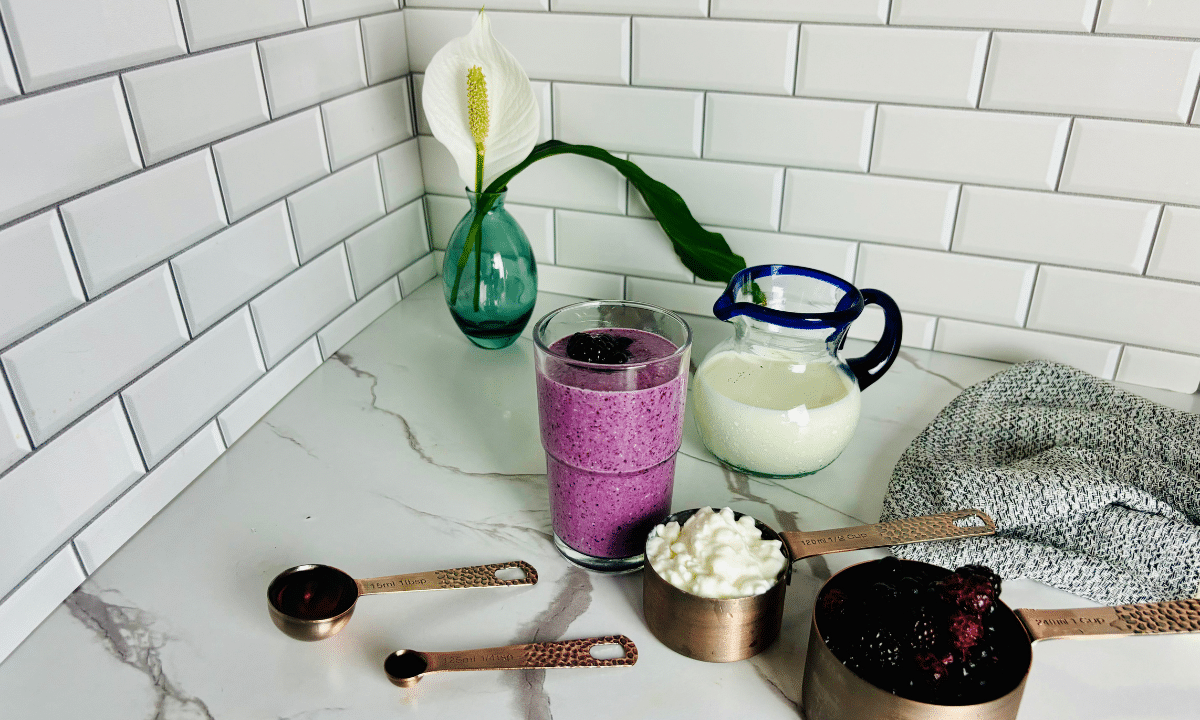
This berry cottage cheese smoothie tastes like a slice of berry cheesecake in a glass, and it has 33 grams of protein. It takes five minutes, uses ingredients you probably already have, and it’s one of the smoothies I recommend most to my patients on GLP-1 medications and in menopause.
Below you’ll find the recipe, plus my favorite ways to add protein to any smoothie, with or without protein powder.
Why You’ll Love This Smoothie
- It tastes like dessert. Cottage cheese and frozen berries blend into something that really does taste like cheesecake.
- 33 grams of protein in one glass.
- Five minutes, one blender. Add everything, blend, done.
- Easy on low-appetite days. A cold smoothie goes down easier than a plate of food when your appetite is low.
Why Cottage Cheese in a Smoothie?
Cottage cheese makes this smoothie thick and creamy, and once it’s blended you can’t taste the curds. One cup of 2% cottage cheese has about 24 grams of protein, plus calcium.
Protein matters even more in midlife. As estrogen drops in menopause, it gets harder to hold on to muscle, and if you’re losing weight on a GLP-1, you want that weight to come from fat, not muscle. Eating enough protein and doing strength training help protect it.
One thing to know: cottage cheese is salty. One cup can have close to half a day’s sodium. If you’re watching your sodium, choose a low-sodium or no-salt-added cottage cheese.
Why Berries?
Berries balance the cottage cheese’s creaminess with a little tartness. They also bring fiber, vitamin C, and antioxidants, and frozen berries are just as nutritious as fresh, cheaper, and they make your smoothie cold and thick without ice.
How to Make a Berry Cottage Cheese Smoothie
Add everything to a blender and blend until smooth and creamy. Serve cold.
Ingredients
- 1 cup 2% low-fat cottage cheese
- ½ cup 2% reduced-fat cow’s milk or high-protein plant-based milk, such as soy milk
- 1 cup mixed frozen berries
- ½ tablespoon maple syrup
- ½ teaspoon vanilla extract

Instructions
- Add all the ingredients to a blender.
- Blend until smooth and creamy.
- Pour into your favorite glass, and enjoy!
Notes
Nutrition
Ways to Change It Up
- Less sugar: skip the maple syrup, or use a little stevia or monk fruit.
- Extra greens: add a handful of spinach. You won’t taste it.
- Different fruit: try frozen mango, cherries, or pineapple.
- Chocolate version: add 1 tablespoon of unsweetened cocoa powder.
- Thicker: use less milk and eat it with a spoon as a smoothie bowl.
More Ways to Add Protein to Any Smoothie
Protein powder works, but it’s not the only way. These are the add-ins I suggest most to my patients. Mix and match until you get to at least 20 to 30 grams in your smoothie.
| Add-in | Amount | Protein |
|---|---|---|
| Cottage cheese, 2% | 1 cup | about 24 g |
| Plain nonfat Greek yogurt | 3/4 cup | about 17 g |
| Hemp seeds | 3 tablespoons | about 9 g |
| Cow’s milk | 1 cup | about 8 g |
| Soy milk | 1 cup | about 8 g |
| Peanut butter | 2 tablespoons | about 7 g |
| Powdered peanut butter | 2 tablespoons | about 6 g (check your label) |
| Silken tofu | 1/2 cup | about 6 g |
| Chia seeds | 2 tablespoons | about 4 g |
Greek Yogurt
Greek yogurt adds protein and a tangy, creamy texture. Choose plain or low-sugar, and add your own fruit for sweetness.
Milk
Not all milks are equal when it comes to protein. Cow’s milk and soy milk both have about 8 grams per cup. Pea protein milks, like Ripple, have about the same. Almond, oat, and coconut milk have very little, so if you use them, get your protein from something else in the blender.
Peanut Butter and Powdered Peanut Butter
Two tablespoons of peanut butter add about 7 grams of protein and a lot of flavor, but also close to 200 calories. Powdered peanut butter gives you almost the same protein with far fewer calories, and it blends right in.
Hemp Seeds and Chia Seeds
Hemp seeds are the protein winner of the seeds, with about 9 grams in 3 tablespoons. Chia seeds have less protein but more fiber, and they thicken your smoothie. For a smoother drink, soak the chia seeds in a little of your milk for 5 minutes before you add everything else.
Silken Tofu
This may sound strange, but silken tofu blends in completely, has almost no flavor, and adds protein. It’s a great option if you don’t eat dairy.
Protein Powder
If you do use protein powder, one scoop usually adds 20 to 25 grams. Look for one with third-party testing, like NSF Certified for Sport, so you know what’s in it.
A Smoothie for Low-Appetite Days
I often hear from my patients on GLP-1 medications that after a dose increase, or the day or two after their shot, their appetite drops so much that eating a full meal feels impossible. That’s when a cold smoothie helps. It’s easy to sip slowly, and you still get the protein your body needs.
If you’re dealing with nausea, too, read my tips on GLP-1 Nausea Relief.
Like This Recipe?
Make it your own, and if you share it on Instagram, tag me @nutritionwithdrsu. I’d love to see it!
Looking for more protein ideas? Get my free High-Protein Foods List, or try my 2-Ingredient Cottage Cheese Bread.
All information on this site is meant for educational purposes only and should not be used in place of advice from a medical professional.

Dr. Su-Nui Escobar, DCN, RDN, FAND, is a Miami-based weight loss dietitian specializing in women in menopause who use GLP-1 medications. She holds a doctorate in clinical nutrition from the University of North Florida and is a national speaker, writer, and author of The GLP-1 Kitchen. She is a former spokesperson for the Academy of Nutrition and Dietetics.person.