
Most people I work with on a GLP-1 love the progress they’re making, and they’re worried about losing it. They’ve heard the stories about people who stopped their medication and gained the weight back, and they don’t want that to be them.
That worry is one of the biggest reasons people come to see a dietitian. It’s a good instinct, because the habits you build while you’re on the medication carry you forward after you stop.
Whether you take Zepbound, Wegovy, Foundayo, or one of the upcoming GLP-1 medications, here’s what helps you keep the weight off, why it can be harder in menopause, and what successful people do differently.
Medical disclaimer: This content is for educational purposes only and is not a substitute for medical advice, diagnosis, or treatment.
Why People Stop Taking a GLP-1
There are plenty of reasons, and most of them have nothing to do with willpower:
- Cost or insurance. Coverage for weight loss can be denied or stop.
- Side effects that go beyond mild nausea or constipation.
- Reaching a goal and wanting to see how you do without it.
- A plateau or slower progress.
- Life changes, like surgery, illness, or stress.
It’s also very common. Only about a third to half of people are still taking their GLP-1 a year after starting.
What Happens When You Stop
GLP-1 medications quiet your appetite and help you feel full sooner. When you stop, that help goes away, and your body notices:
- Hunger comes back
- Cravings get louder
- Old habits, like eating when you’re stressed or bored, can show up again
In one clinical trial, people who stopped tirzepatide (Zepbound) gained back about 14% of their body weight in the year after they stopped. With semaglutide (Wegovy), people regained about two-thirds of the weight they had lost in the first year.
That’s not a personal failure. Weight regain happens after every kind of weight loss, including diet changes and bariatric surgery. It’s your body doing what bodies do. Knowing it ahead of time is what lets you plan for it.
Real life can look more hopeful. In a study of more than 4,000 people’s health records, about two out of three kept their weight steady or kept losing in the 6 months after their last semaglutide or tirzepatide prescription. People who kept the weight off were more likely to receive exercise advice from their care team. Six months isn’t long, and not everyone in that study had actually stopped, but it shows regain isn’t a given.
Why It Matters Even More in Menopause
When you lose weight, you lose both fat and some muscle. When weight comes back, it tends to come back as more fat than muscle.
The menopause transition already pushes in the same direction: it makes it easier to lose muscle and gain fat, especially around the middle. So losing weight, regaining it, and repeating can leave you with less muscle than when you started. That’s why the habits below focus so much on protecting your muscle.
Plan Your Transition Off the Medication
If you and your healthcare provider decide it’s time to stop, a plan makes a big difference:
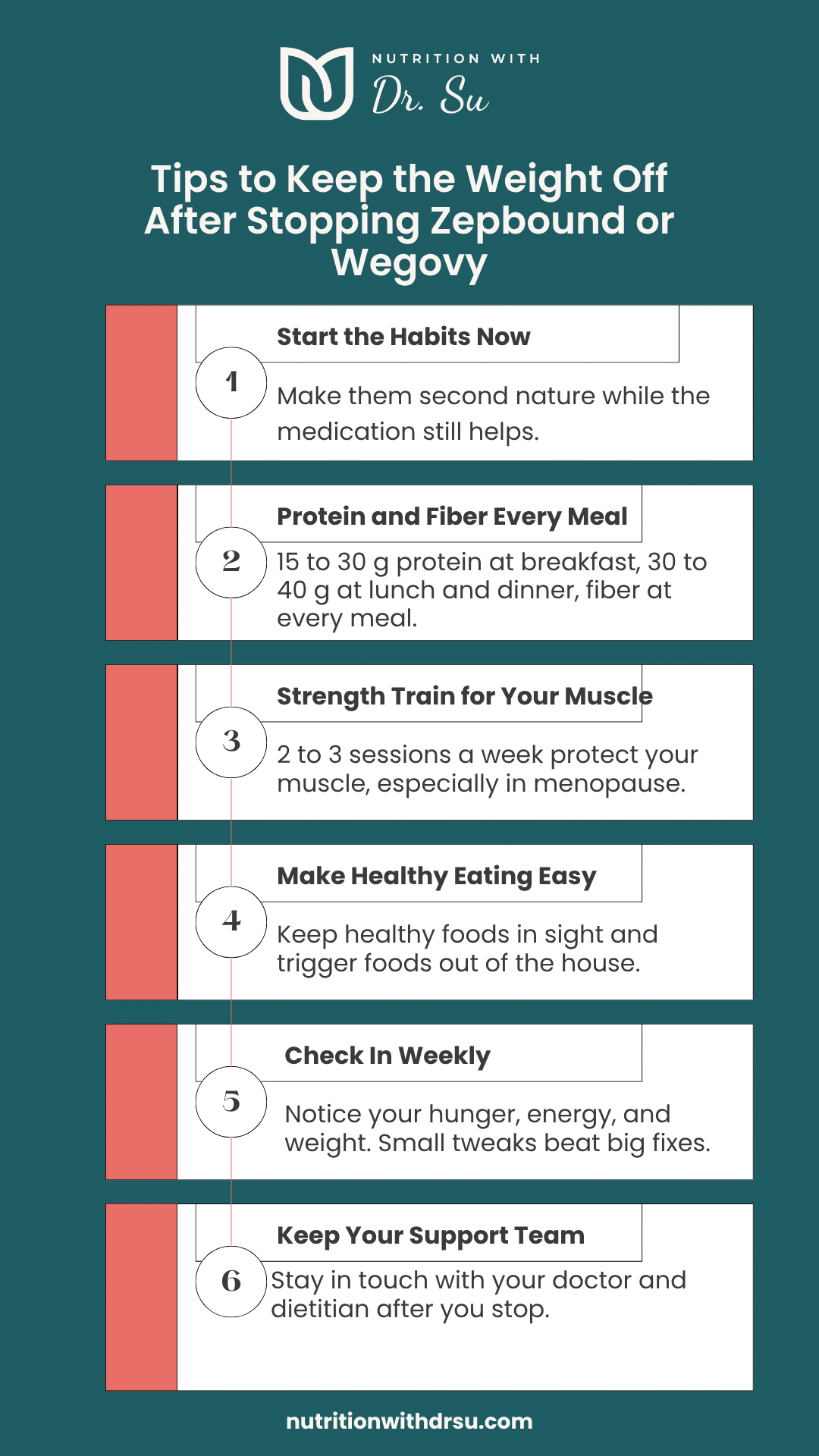
- Start the habits now. Make them second nature while the medication is still helping with your appetite, so they can carry you through the hunger and cravings when it isn’t. That’s the best time to work with a dietitian.
- Ask about tapering. Some providers lower the dose slowly instead of stopping all at once, to ease the return of hunger. There’s no official way to do this yet, and the research on tapering and microdosing is still very limited, so it’s a conversation to have with your provider.
- Check in weekly. Notice your hunger, your energy, and your weight. Small tweaks are easier now than fixing a bigger change later.
- Keep your support team. Stay in touch with your provider and your dietitian after you stop, not just before.
The Biggest Difference: How You Approach Food
People who keep the weight off long term change more than what’s on their plate. They’ve changed the way they approach food, and they’ve built a food environment around them that makes the better choice the easy one.
Your Mindset
The biggest change is hard to describe, but I can see it when it happens. People stop seeing this as a diet. Healthy food stops feeling like a punishment, something unpleasant they have to get through until they can go back to “normal.” It becomes the way they take care of their bodies, and they start to enjoy eating this way.
One of my patients put it perfectly: now she has the skills and the habits, and she doesn’t think twice. Things that used to be automatic, like stopping to buy food on her way home, just aren’t her habits anymore.
- Eat for hunger, stop when you’re satisfied. The medication made fullness loud. Without it, you have to listen for it, so slow down and check in halfway through your meal.
- Food isn’t a reward or a punishment. A long day doesn’t earn dessert, and one big meal doesn’t mean you have to “make up for it” tomorrow.
- Consistent, not perfect. My patients who keep the weight off don’t eat all the time perfectly. They’re kind to themselves, and they stay consistent. On vacation, they might eat a little extra, but they don’t go all out. And as soon as they’re home, they’re back to their routine. No guilt, no waiting for Monday.
Your Food Environment
- Your kitchen. Keep the foods that support you easy to see and easy to grab. Keep your personal trigger foods out of the house, or at least out of sight.
- Your routines. Plan your meals, keep regular meal times, and shop with a list.
- Where you eat. Eat at the table when you can, not in front of the TV, at your desk, or in the car.
- The people around you. Let your family know what you’re working on, and plan ahead for parties, work events, and eating out.
On the medication, it was easier to ignore the candy jar on the counter. Without it, your environment has to do some of that work for you.
Eating Habits That Help You Keep the Weight Off
The biggest thing I see in the patients who keep the weight off is how they build their habits. Choosing better foods every day, with the focus on protein and fiber, becomes second nature. They don’t have to think about it anymore.
You’ve probably heard these habits a hundred times. Hearing them a lot doesn’t make them any less true, and they’re the ones I see working:
- Make protein the center of every meal. Aim for 15 to 30 grams at breakfast and 30 to 40 grams each at lunch and dinner, and choose protein when you snack. It keeps you full and helps you hold on to muscle. Need ideas? My High-Protein Foods List has more than 60 protein foods and a free printable.
- Get fiber at every meal. Vegetables, fruit, beans, lentils, and whole grains keep you fuller longer, which is part of what the medication was doing for you. Filling about half your plate with vegetables helps when your appetite comes back.
- Eat your vegetables first and your carbs last. Start with a small amount of vegetables, then your protein, then your carbs. It can help lower blood sugar spikes, which matters more as insulin resistance rises in menopause.
- Keep carbs to about 1 cup per meal. Choose fiber-rich ones, like beans, whole grains, or a couple of corn tortillas. Sugary drinks, like soda, juice, and sweetened coffee drinks, are an easy place to cut back.
Strength Train and Keep Moving
Strength training two to three times a week is one of the best ways to protect your muscle. If weights feel intimidating, start with bodyweight exercises, resistance bands, or Pilates.
On the other days, move in a way you enjoy: walking, dancing, swimming. Aim for at least 150 minutes of moderate activity a week. Consistency matters more than intensity.
Movement you do all day counts too, not just your workouts. Taking the stairs, walking while you’re on the phone, and getting up from your desk every hour all add up. This matters even more in midlife, when many of us spend more of the day sitting, especially with desk jobs.
Take Care of Sleep, Stress, and Emotional Eating
- Sleep. Short nights make you hungrier the next day and make cravings harder to ignore. A calm routine and less screen time before bed help.
- Stress and emotional eating. If you notice yourself reaching for food when you’re stressed, bored, or overwhelmed, try something else first: a walk, a call to a friend, a few deep breaths. If it keeps happening, a therapist or support group can help.
If the Scale Starts Creeping Up
This is the part most people fear, so it helps to have a plan before it happens.
- Pick your number ahead of time. Decide now what change on the scale means it’s time to act, so a small bump doesn’t become a big one before you notice.
- Go back to the basics. Eat protein at every meal, eat vegetables first, keep carbs around 1 cup, and stick to your usual routine. Most of the time, that’s enough to turn it around.
- Look at what changed. A new schedule, more stress, less sleep, or the snacks that crept back into the pantry. Fix the cause, not just the number.
- Reach out early. Call your dietitian or your doctor while it’s a few pounds, not after it’s a lot. Going back on the medication is also a conversation you can have with your doctor. It’s not a failure.
Staying on the Medication Is an Option Too
GLP-1 medications are meant to be long-term treatments, just like blood pressure or cholesterol medications. People who keep taking them are most likely to keep the weight off.
If you can stay on it, that’s a valid choice, and it’s worth talking through with your doctor before you decide to stop.
You Don’t Have to Do This Alone
The best time to start working on keeping the weight off isn’t when you’re getting ready to stop your medication. It’s while you’re still on it. When we start early, you won’t scramble to catch up later. Your habits change little by little, while the medication is still helping, so by the time you stop, they’re already part of your life.
If you’d like help planning your transition off a GLP-1, or keeping your results once you’ve stopped, I work with patients one-on-one and accept insurance. Book your appointment here.
Dr. Su-Nui Escobar, DCN, RDN, FAND, is a Miami-based weight loss dietitian specializing in women in menopause who use GLP-1 medications. She holds a doctorate in clinical nutrition from the University of North Florida and is a national speaker, writer, and author of The GLP-1 Kitchen. She is a former spokesperson for the Academy of Nutrition and Dietetics.person.